
Deepfake Detection in the Age of Gen AI: Why Integrated Solutions are Key
.png)
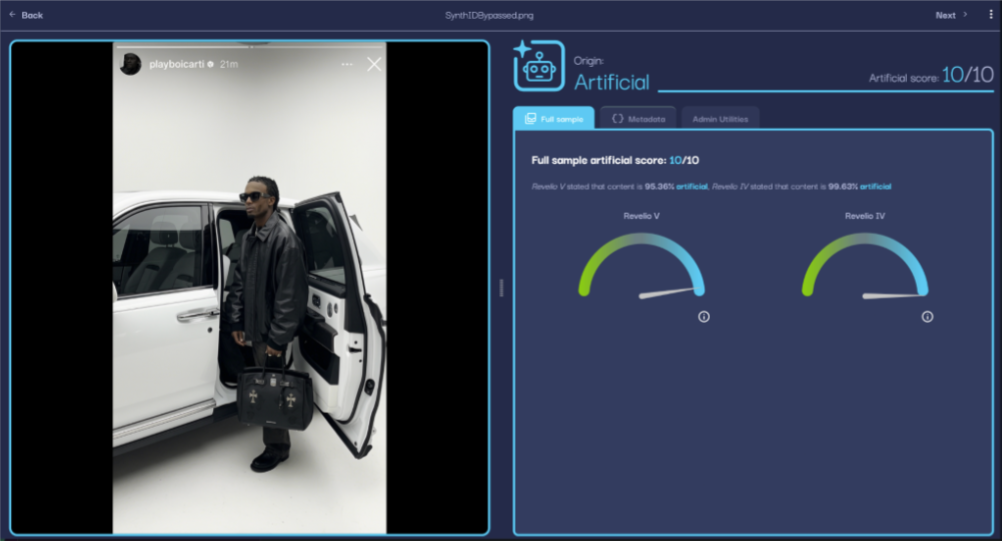
In the fight against deepfakes, relying solely on watermarking leaves digital trust exposed. No single solution can fully address the evolving threats of synthetic media. Even advanced technologies like SynthID — designed to embed robust watermarks — can be bypassed, as researchers demonstrated by removing the watermark while preserving high-quality content.
At identifAI, we believe that a single layer of defense is never enough. That's why we champion a multi-layered, integrated approach, combining complementary detection technologies to safeguard media integrity and ensure reliable deepfake detection in the age of Gen AI.
A Wake-Up Call for the Industry: The Deepfake Arms Race Is Accelerating—and Demands Integrated Solutions
The battle between content authentication and circumvention is intensifying. Every improvement in detection triggers new methods to evade it, making the deepfake arms race an ongoing challenge for digital trust.
Why Watermarking Alone Cannot Win
Watermarking technologies like SynthID, developed by Google DeepMind, are a meaningful step forward in synthetic media authentication. By embedding invisible markers into AI-generated content, they enable provenance tracking and origin verification. In controlled environments, where attribution is the goal, this approach is effective and valuable.
The question is not whether watermarking works. The question is whether it is sufficient on its own — and the SynthID bypass provides a clear, technically grounded answer.
What Happened with SynthID
Researchers demonstrated that SynthID's watermark could be removed through a relatively accessible and now publicly documented pipeline. A GitHub proof-of-concept (SynthID Bypass) demonstrates an approach to bypass it. The method combines three steps: low-denoise regeneration to strip the watermark-carrying pixels, structural guidance to preserve the overall composition of the image, and targeted face repair to maintain human detail. The result is synthetic content that has lost its attribution signal while retaining its quality and persuasiveness.
This highlights a broader structural limitation: any detection method based on a single solution introduces a single point of failure. This is why multi-layered integrated detection solutions are essential.
Deepfake Detection with identifAI
At identifAI, we analyse the content itself, identifying generative artifacts left by AI models. These artifacts persist even after post-processing, watermark removal, or when no watermark was applied at all.
This enables identifAI to determine whether content is human-made or AI-generated regardless of its origin or metadata. It is not a replacement for watermarking — it is the complementary layer that closes its gaps.
Key Principles for the Future of Digital Trust
As Gen AI becomes faster, cheaper, and more accessible, detection infrastructure must scale alongside content generation. The ongoing arms race in deepfake detection can only be addressed by embracing a strategic, multi-layered approach:
1. Move Beyond the “Silver Bullet” Myth
Relying on a single detection method is a dangerous illusion. Deepfakes are a systemic, adversarial threat, and the only defensible approach is a multi-layered, integrated ecosystem: detection systems that operate in parallel, span multiple formats, continuously update, and adapt to the next generation of AI-generated content. A single solution is not a strategy—it’s a vulnerability.
2. Integration Is Essential
Even advanced watermarking solutions like SynthID cannot provide complete protection on their own. True security comes from a unified, multi-layered approach. By combining complementary technologies, organizations achieve robust, reliable, and high-performing deepfake detection capable of withstanding sophisticated circumvention attempts.
3. Setting a New Standard for Deepfake Detection
identifAI was designed as the essential infrastructure for cross-platform deepfake detection. Operating as an independent, content-level analysis layer, it complements existing security systems and delivers a resilient, integrated defense that establishes a new industry standard.
At identifAI we believe that the most reliable way forward is integration and that’s why we promote a multi-layered detection strategy as a new standard for deepfake detection. By combining our solutions in synergy with internal security systems, organizations can leverage each technology’s strengths, creating a more effective and resilient deepfake detection system than any other standalone tool.
Watermarking may be part of the answer. Integration is the key.
Try identifAI Today
identifAI is not just a tool— it is the foundation for trusted digital media in the age of Gen AI. Embedded directly into platform pipelines, it ensures detection is proactive, comprehensive, and resistant to circumvention.
- 📩 Contact us today to see how identifAI can help your organisation or business to stay ahead in the fight against deepfake fraud
- 🎯Book a demo so our experts can guide you in the use of our tools.
- 🔍 Try identifAI now and see how easy it is to uncover the truth.
About identifAI
identifAI is an Italian startup that has developed an innovative AI platform capable of detecting whether images or videos were created by humans or generative AI. Its proactive solutions promote digital integrity, protect against misinformation, and empower users to distinguish between human and AI-generated content. In July 2025, identifAI raised €5 million in a funding round led by United Ventures, reflecting a continued commitment to developing anti-deepfake technologies and promoting a secure information ecosystem.
Communication
pr.it@identifai.net | pr.uk@identifai.net
For more information: www.identifai.net
talk to a human expert
Tell us about your business. We'll come back to you within one business day.
No sales pitch. Just a conversation.
identifAI - Find Origin





Gartner does not endorse any vendor, product or service depicted in its researchpublications, and does not advise technology users to select only those vendors with thehighest ratings or other designation. Gartner research publications consist of the opinions ofGartner’s research organization and should not be construed as statements of fact. Gartnerdisclaims all warranties, expressed or implied, with respect to this research, including anywarranties of merchantability or fitness for a particular purpose. GARTNER is a registeredtrademark and service mark of Gartner, Inc. and/or its affiliates in the U.S. and internationallyand is used herein with permission. All rights reserved.