
identifAI Is the First Deepfake Detection Company to Achieve C2PA Conformance
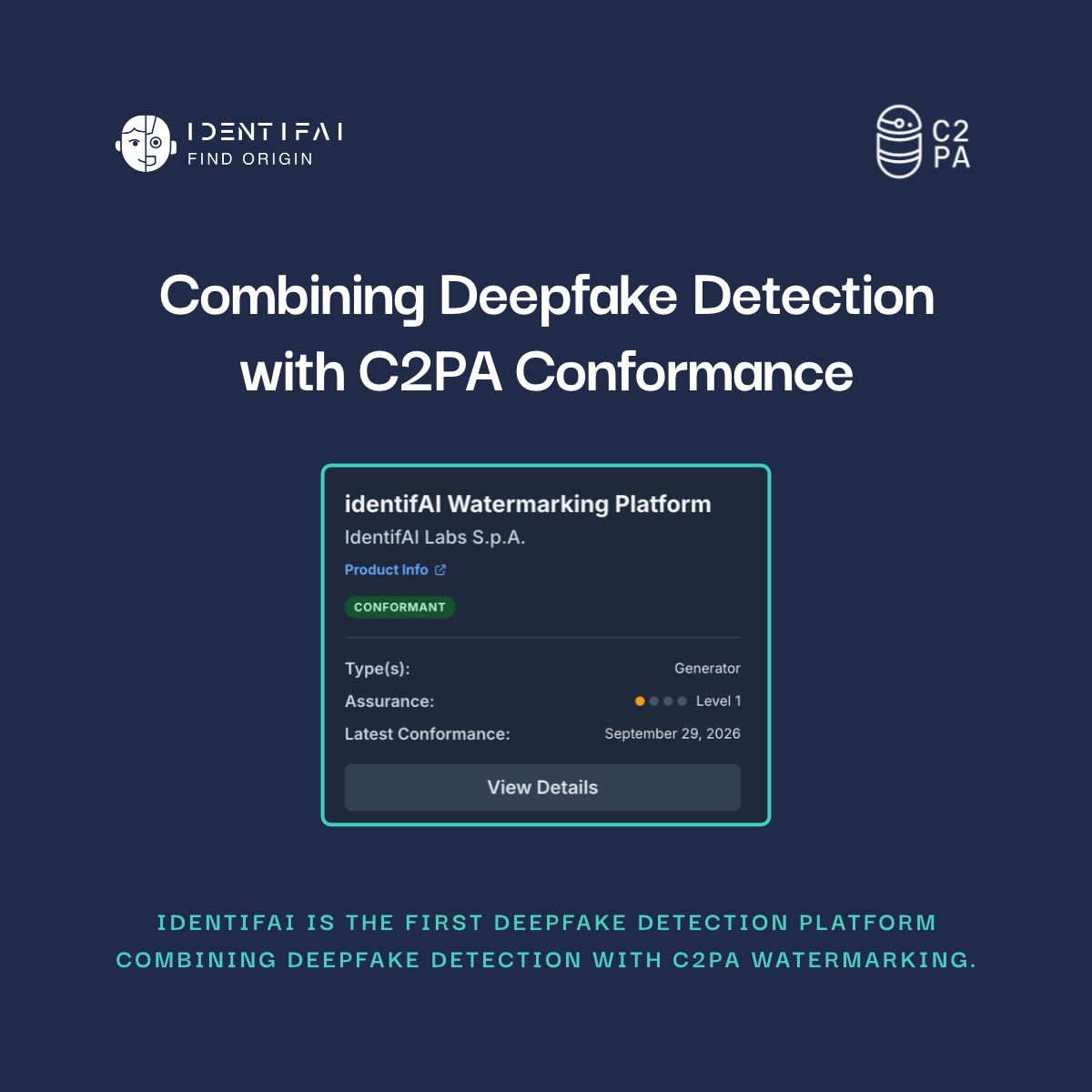
identifAI Is the First Deepfake Detection Company to Achieve C2PA Conformance
identifAI is the first deepfake detection company to pass C2PA conformance. Our platform is now listed in the official C2PA Conformance Explorer, confirming that our approach to verification and provenance has been independently assessed against the open standard for digital content authenticity.
Because many files carry no credentials, or have had them removed, we pair this standards-based validation with deepfake detection, so organisations get evidence both when content has a verifiable history and when it doesn’t.
What is C2PA?
C2PA stands for the Coalition for Content Provenance and Authenticity. It is an open technical standard that records where a piece of digital content came from and how it has changed over time. This information, often called Content Credentials, travels with an image, video or audio file, so anyone can check its origin and edit history.
What does C2PA conformance mean?
Conformance is a formal check that a product implements the C2PA specification correctly. Products that pass are listed in the public Conformance Explorer, where anyone can verify the claim.
For identifAI, this means our verification and provenance capabilities have been assessed against the standard, not just described in our own marketing. For customers, it means results built on an open, interoperable framework that other tools and platforms recognise.
Why we combine C2PA validation with deepfake detection
Detection and provenance answer two different questions. Detection asks whether content shows signs of AI generation or manipulation. Provenance asks where content came from and whether its history can be verified.
Neither is enough alone. Provenance data can be missing or stripped when files are shared, and detection can only assess likelihood. Together they give organisations stronger evidence: a verified origin where one exists, and forensic analysis where it does not. identifAI brings both approaches together in one platform.
Why it matters for every business
Synthetic media is no longer a niche risk. Anyone can now generate a convincing face, voice, document or video in minutes, and any process that relies on a photo, a recording or a scanned file as proof is exposed. Trust in digital evidence has become a business problem, not just a media one.
- Banking and KYC: Deepfakes and synthetic identities can be used to pass remote onboarding and identity checks. Verifying that a selfie, video or ID document is genuine helps reduce fraud and supports compliance.
- Insurance: Claims often depend on customer-submitted photos and videos. AI-edited images of damage or fabricated evidence can lead to false payouts, so claims teams need a reliable way to confirm authenticity.
- Media and publishing: Editorial credibility depends on knowing that images and footage are real before they are published.
- Brands and marketing: Impersonation, fake endorsements and fabricated content can damage reputation and customer trust.
- HR and recruitment: Remote hiring is vulnerable to candidates using deepfake video or voice to impersonate someone else.
- Legal and public sector: Digital evidence needs a clear, defensible record of where it came from and whether it has been altered.
Across all of these, organisations need verification that is fast, repeatable and based on recognised standards, so that decisions about what is real do not rest on guesswork. Built on C2PA, identifAI gives teams in every sector evidence they can document, audit and defend.
A standards-based approach to digital trust
Trust in the AI era depends on transparency and accountability. Open standards matter because they let different tools, platforms and organisations verify content the same way, instead of relying on closed, proprietary claims. By achieving C2PA conformance, identifAI is helping build a digital ecosystem where authenticity can be checked, not assumed.
Frequently asked questions
What is C2PA conformance?
It is a formal assessment confirming that a product correctly implements the C2PA content provenance standard. Conformant products are listed in the public C2PA Conformance Explorer.
Is identifAI listed in the C2PA Conformance Explorer?
Yes. identifAI’s platform is listed in the official Conformance Explorer.
How is deepfake detection different from content provenance?
Detection analyses content for signs of AI generation or manipulation. Provenance records and verifies the origin and edit history of content. They complement each other.
Why do we combine them together?
C2PA Content Credentials can tell you where a file came from and how it has been edited, but only when those credentials exist. Most images, videos and audio files circulating today carry none, and credentials can be lost when a file is screenshotted, compressed or re-uploaded. Even when credentials are present, they describe a file’s history; they do not show whether the content itself has been synthetically generated or manipulated. Deepfake detection closes that gap by analysing the content directly. By combining the two, identifAI gives organisations evidence in both situations: a standards-based validation result when a file has verifiable credentials, and forensic analysis when it does not. For teams handling onboarding checks, insurance claims or evidence review, that means fewer blind spots and results they can document and defend.
Talk to our team to see how identifAI supports content authenticity for your organisation. sales@identifai.net
talk to a human expert
Tell us about your business. We'll come back to you within one business day.
No sales pitch. Just a conversation.
We stand for truth





Gartner does not endorse any vendor, product or service depicted in its researchpublications, and does not advise technology users to select only those vendors with thehighest ratings or other designation. Gartner research publications consist of the opinions ofGartner’s research organization and should not be construed as statements of fact. Gartnerdisclaims all warranties, expressed or implied, with respect to this research, including anywarranties of merchantability or fitness for a particular purpose. GARTNER is a registeredtrademark and service mark of Gartner, Inc. and/or its affiliates in the U.S. and internationallyand is used herein with permission. All rights reserved.