
identifAI Launches REVELIO FACE III: AI Face Deepfake Detection | identifAI
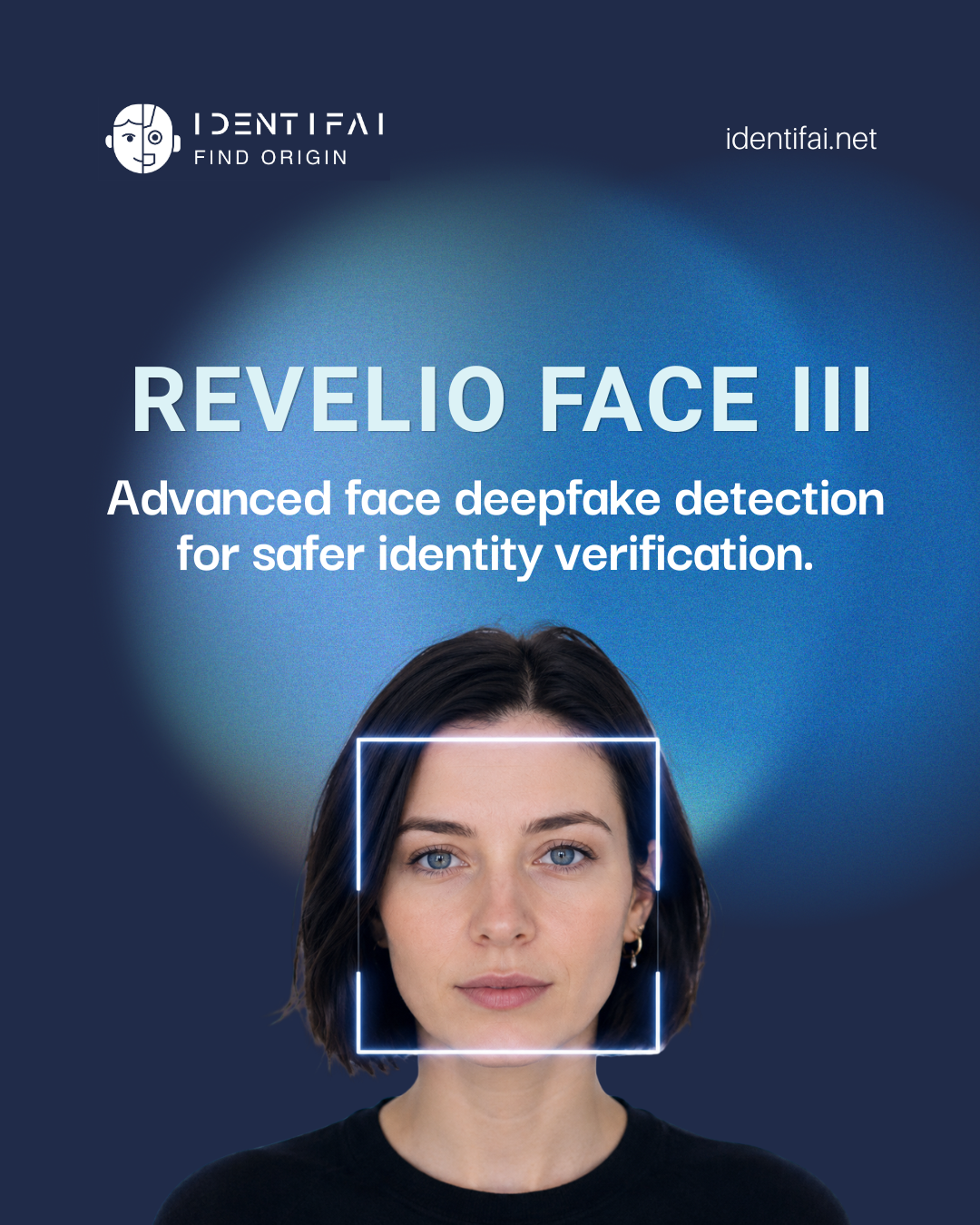
identifAI Launches REVELIO FACE III to Strengthen Identity Verification Against AI-Powered Attacks
REVELIO FACE III is identifAI's latest face deepfake detection model, designed to detect face-swapped selfies, synthetic avatars and camera injection attacks at the point of submission. With improved performance in video calls, facial manipulation detection and analysis of faces generated by recent video models, REVELIO FACE III helps organisations strengthen identity verification and digital onboarding workflows.
As generative AI makes synthetic faces increasingly realistic, identity verification systems face a growing challenge: distinguishing genuine users from sophisticated attempts to impersonate them.
Face swaps, AI-generated avatars and manipulated camera feeds can all be used to undermine digital identity checks. For organisations operating online, detecting these attacks at the point of submission is becoming increasingly important.
Today, identifAI announces the launch of REVELIO FACE III, its latest face deepfake detection model, built to protect identity verification and onboarding flows against increasingly sophisticated synthetic identity attacks.
What is REVELIO FACE III?
REVELIO FACE III is an AI-powered face deepfake detection model designed to identify suspicious facial media submitted during identity verification and onboarding processes.
The model focuses on three important attack categories:
- Face-swapped selfies: images or video submissions in which a person's face has been replaced or manipulated using AI.
- Synthetic avatars: faces generated entirely by artificial intelligence, including those created using modern video generation models.
- Camera injection attacks: attempts to submit manipulated or synthetic camera feeds instead of a genuine live camera capture.
By analysing facial media at the point of submission, REVELIO FACE III helps organisations identify potential attacks within identity verification workflows.
Measurable improvements in detection performance
REVELIO FACE III introduces targeted performance improvements across three challenging scenarios: compressed video calls, facial manipulation and faces generated by recent AI video models.
Please note: All performance improvements are measured against REVELIO FACE II using identifAI's internal evaluation datasets. Results reflect the specific test conditions and may vary across deployment environments.
1. Improved performance in video calls
+15% accuracy in video calls
Video streaming platforms can compress video, reducing image quality and making facial analysis more challenging.
REVELIO FACE III delivers improved accuracy when analysing faces affected by the compression typically introduced during video streaming. This helps address a practical challenge in real-world verification scenarios, where video quality may vary significantly.
2. Stronger detection of facial manipulations
10% lower false negative rate on facial manipulations
AI-powered facial alterations can make manipulated faces increasingly difficult to identify.
REVELIO FACE III improves detection performance on facial manipulations, reducing the false negative rate by 10% and strengthening the ability to identify altered facial content.
Performance improvements measured vs. previous model Revelio Face II
3. Improved detection of faces generated by recent video models
7.5% lower false negative rate on recent video generators
The rapid development of video generation models is making synthetic faces more realistic and increasingly difficult to distinguish from genuine ones.
REVELIO FACE III improves detection performance against faces generated by recent video synthesis models, reducing the false negative rate by 7.5%.
These improvements are designed to address the evolving techniques used to create and submit synthetic facial media.
Built to protect identity verification and onboarding
Identity verification is a critical security layer for organisations onboarding users remotely.
A face-swapped selfie, a synthetic avatar or an injected camera feed can undermine the reliability of a verification process if it goes undetected.
REVELIO FACE III is designed to help organisations strengthen their defences against these attacks at the point of submission, supporting workflows such as:
- Know Your Customer (KYC)
- Digital identity verification
- Remote customer onboarding
- Fraud prevention
- Financial services and fintech
- Insurance onboarding
- Other digital services requiring face-based identity checks
By focusing on face-based synthetic media and camera injection attacks, REVELIO FACE III provides an additional layer of detection to help organisations make their identity verification processes more resilient.
Staying ahead of synthetic identity fraud
Generative AI is lowering the barriers to creating convincing synthetic faces and manipulating facial media. At the same time, new video generation techniques are introducing additional challenges for identity verification systems.
Detection models must therefore evolve alongside the attacks they are designed to identify.
With REVELIO FACE III, identifAI continues to advance face deepfake detection through targeted improvements in video call analysis, facial manipulation detection and the identification of faces generated by recent video models.
The objective is clear: help organisations identify increasingly sophisticated synthetic identity attacks before they compromise digital onboarding and verification workflows.
Want to know more? Book a demo or talk with one of our experts: sales@identifai.net
Frequently Asked Questions
What is REVELIO FACE III?
REVELIO FACE III is identifAI's latest face deepfake detection model, built to protect identity verification and onboarding workflows against synthetic facial media and related attacks.
What attacks can REVELIO FACE III detect?
REVELIO FACE III is designed to detect face-swapped selfies, synthetic avatars and camera injection attacks at the point of submission.
How does REVELIO FACE III improve detection performance?
The model delivers three key improvements:
- 15% higher accuracy in video calls.
- 10% lower false negative rate on facial manipulations.
- 7.5% lower false negative rate on faces generated by recent video models.
Why is video call analysis important for identity verification?
Video compression can affect the quality of facial media and make analysis more challenging. Improved performance in compressed video helps address the conditions encountered in real-world video verification workflows.
What is a camera injection attack?
A camera injection attack involves supplying a manipulated or synthetic camera feed instead of a genuine live camera capture. Such attacks can be used to attempt to bypass identity verification controls.
How can REVELIO FACE III help prevent identity fraud?
By detecting suspicious facial media at the point of submission, REVELIO FACE III can provide an additional detection layer within identity verification and onboarding processes, helping organisations identify potential synthetic identity attacks.
Which industries can use REVELIO FACE III?
The model is designed for organisations that rely on face-based identity verification, including financial services, fintech, insurance and other businesses with digital onboarding or KYC requirements.
Is REVELIO FACE III available now?
REVELIO FACE III is available from October 9. To learn more or schedule a demo, contact sales@identifai.net or visit our website.
The more sophisticated the attack, the stronger identity verification needs to be.
talk to a human expert
Tell us about your business. We'll come back to you within one business day.
No sales pitch. Just a conversation.
We stand for truth





Gartner does not endorse any vendor, product or service depicted in its researchpublications, and does not advise technology users to select only those vendors with thehighest ratings or other designation. Gartner research publications consist of the opinions ofGartner’s research organization and should not be construed as statements of fact. Gartnerdisclaims all warranties, expressed or implied, with respect to this research, including anywarranties of merchantability or fitness for a particular purpose. GARTNER is a registeredtrademark and service mark of Gartner, Inc. and/or its affiliates in the U.S. and internationallyand is used herein with permission. All rights reserved.